Lethbridge Harm Reduction

the History of colonization
in Canada
Stigmatizing discourse can be linked to the overrepresentation of populations experiencing challenges with substance use disorder. To eliminate stigmatization, it is important for individuals to develop an understanding of the history of colonization that is the root of issues that manifest in systemic oppression and negative social outcomes.
Geography and Demographics
Two reservations in close proximity to Lethbridge that belong to the Blackfoot Confederacy are the Nations of Kainai-Blood Tribe and Peigan-Piikani. The Kainai-Blood Tribe population on reserve in 2016 was 4,510 [1]. The Peigan-Piikani population on reserve in 2016 was 1,544 [1]. According to the 2016 census data, Lethbridge is home to 6,132 people of Aboriginal identity [2].
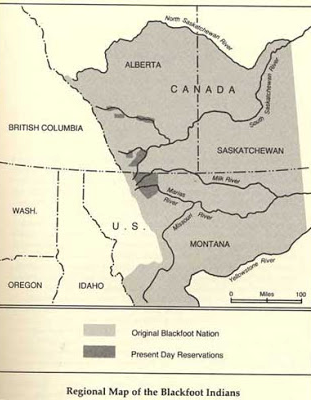

To get a sense of the landmass that was lost by the members of the Blackfoot Confederacy during colonization, consider these two maps. The left showing the Original Blackfoot Nation and the present day, and the right showing the current reservations located around Lethbridge.
Historical Timeline of Colonization in Canada
Colonization timeline
The history of colonization in Canada is lengthy, complex, and riddled with Eurocentric policies, treaties, institutions, and actions clearly targeting the elimination of the culture of the Indigenous people. Indigenous people across Canada were subjected to disease that diminished the population, policies that banned cultural practices and language, reservation land allocation that stripped them of their traditional territories, and treaties that were structured for ongoing dependence rather than sovereignty and independence. The Final Report of the Truth and Reconciliation Commission of Canada (2015), provides an extensive historic account of colonization in Canada, including an in-depth account of Residential Schools. A brief timeline of significant events is outlined below. The timeline provides perspective on the continued path of Eurocentric domination, quest for total control, and cultural genocide rationalized by illusions of racial and cultural superiority.
[1] All information in the Historical Timeline is synthesized and drawn from the final “Report of the Truth and Reconciliation Commission of Canada” (2015), online information provided by Indigenous and Northern Affairs Canada (https://www.aadnc-aandc.gc.ca/eng/1100100013778/1100100013779) and Historica Canada Education Portal http://education.historicacanada.ca/files/402/Indigenous_Perspectives_Timeline.pdf
Historical Trauma
The Indigenous population whose home is the traditional territory of the Blackfoot people residing in Lethbridge and surrounding reservations are victims of historical trauma. According to the First Nations Health Authority [2], “oppressive and assimilationist colonial policies and practices… including the residential school system as a key contributor to historical trauma... threaten cultural identities and have contributed to high rates of suicide, depression, anxiety, substance abuse, and despair.” Historical trauma is a construct used to “describe the suffering of various ethnic groups, for example, Aboriginal people subjected to colonialism and their descendants” [3]. It is linked to cultural stress and bereavement, described as “grief related to genocide, and racism that has been generalized, internalized, and institutionalized” [4]. It is “cumulative… unresolved…and evidence suggests there is a transmission of trauma across generations” [4].
Statistics Linked to Substance Use Disorder
The statistics linked to substance use disorder illustrate the disproportionate number of Indigenous individuals impacted by the opioid crisis. These statistics reflect one of the many outcomes of historical trauma and systemic oppression that continues as a pervasive risk factor for Indigenous people.
-
A 2017 Alberta Government report found that First Nations people were five times more likely than their non-First Nations counterparts to experience an opioid-related overdose event and three times more likely to die from an opioid-related overdose [7].
-
In Alberta, fentanyl was involved in 18% more opioid-related deaths among First Nations people than non-First Nations [7]
-
In Alberta, First Nations individuals were five times more likely than non-First Nations people to be hospitalized and six times more likely to present at an emergency department (ED) for opioid poisoning.
-
In 2016, the rate of ED visits and hospitalizations related to opioid use and other substances of misuse per 100,000 was highest among First Nations people residing in the South Zone, followed by the Calgary Zone [7.]

The Final Report of the Truth and Reconciliation Commission of Canada (TRC)":
Connections to Substance Use Disorder
Findings conveyed in the TRC report clearly illustrate the historical and systemic roots of the overrepresentation of Indigenous people affected by the opioid crisis. The TRC report confirms that an overall health crisis for Aboriginal people in Canada is a legacy of residential schools, and “the governments in Canada spend billions of dollars each year in responding to the symptoms of the intergenerational trauma of residential schools” and much of this money “is spent on crisis interventions” [8]. Considering the crisis intervention level of dealing with the opioid crisis in Lethbridge absent of investment in strong prevention and treatment strategies, this observation is reflected in the Lethbridge context. Money continues to be infused in crisis intervention rather than proactive prevention strategies and long-term treatment solutions. If the government is serious about changing the trajectory of the substance abuse disorder among Indigenous people, it is time to follow the calls to action of the TRC, including prevention and treatment paths that recognize the worldview of Indigenous people in the Lethbridge area and the healing practices that are part of the culture.
Indigenous Healing
Call to Action 22 of the TRC calls for deliberate recognition of the “value of Aboriginal healing practices” and “collaboration with Aboriginal healers and Elders” [9]. Aboriginal healing practices may be a path that will overcome the trauma of the oppressed and restore health and well-being to some Aboriginal individuals in a holistic way. Health, trauma, and healing are interconnected. “The relationship between loss of control and the onset of poor health has been well-documented in psychology literature” and there has been increasing attention on the potential of Indigenous healing for addressing historical trauma [10].
An Indigenous activist for child welfare and strong proponent for addressing systemic conditions that continue to act as barriers for healthy and strong Indigenous communities, Cindy Blackstock forwards the idea that healing as an outcome of truth and reconciliation actions may require Indigenous peoples taking control of reconciliation themselves [11]. By extension, it follows that Indigenous ways of knowing held by healers, Elders, and Knowledge Keepers, need to be supported as an integral part of healing youth whose health and well-being are affected by historical trauma. Some researchers who have explored Indigenous health, including substance use disorder and effective practices, suggest that in order for “Aboriginal people to devise culturally appropriate healing modalities that will help overcome social disorders resulting from the historic trauma they experience, a people-centered and people-directed approach has to be adopted” [12]. In other words, institutions that support Eurocentric health services need to relinquish control and new structures need to be created that empower Indigenous people to have control over the creation and delivery of support services.
1] Statistics Canada. (2016). 2016 census profile.
[2] Statistics Canada. (2019, August 9). Census profile, 2016 report: Lethbridge [Population centre], Alberta and Alberta [Province].
[3] First Nations Health Authority. (2017). Overdose data and First Nations in BC: Preliminary findings (p. [4]. Retrieved from https://FNHA_OverdoseDataAndFirstNationsInBC_PreliminaryFindings_FinalWeb_July2017.pdf
[5] Denham, A. R. (2008). Rethinking historical trauma: Narratives of resilience. Transcultural Psychiatry, 45(3), 391–414.
[6] Waldram, J. B. (2014). Healing history? aboriginal healing, historical trauma, and personal responsibility. Transcultural Psychiatry, 51(3), 370-386. 10.1177/1363461513487671
[7] Government of Alberta. (2017). Opioids and substances of misuse among First Nations people in Alberta. Edmonton, Alberta: Alberta Health and the Alberta First Nations Information Governance Centre. Retrieved from https://open.alberta.ca/dataset/cb00bdd1-5d55-485a-9953-724832f373c3/resource/31c4f309-26d4-46cf-b8b2-3a990510077c/download/Opioids-Substances-Misuse-Report-FirstNations-2017.pdf
[8] Truth and Reconciliation Commission of Canada. (2015). Summary of the final report of the TRC: Honouring the truth and reconciling for the future. Retrieved from http://nctr.ca/assets/reports/Final%20Reports/Executive_Summary_English_Web.pdf (p. 161, p. 174).
[9] Truth and Reconciliation Commission of Canada. (2015). Calls to action. Retrieved from http://nctr.ca/assets/reports/Calls_to_Action_English2.pdf (p. 3).
[10] Wesley-Esquimaux, C. & Smolewski, M. (2004). Historic trauma and aboriginal healing. [The Aboriginal Healing Foundation Research Series]. Ottawa, Ontario: Aboriginal Healing Foundation. (p. 69).
[11] Blackstock, C. (2009). The occasional evil of angels: Learning from the experiences of Aboriginal peoples and social work. First Peoples Child & Family Review, 4(1), 28-37.
[12] Wesley-Esquimaux, C. & Smolewski, M. (p. 77).
